
Innovative Solutions in Engineering and Telecommunications
Eng. Daniel Morera | Senior ICT
RCDD Expert in Fiber Optic & Structured Cabling Infrastructure and ICT Project Consultant & Trainer
Consulting, training, and design of future-proof telecommunications infrastructure that eliminates unnecessary redesigns and prevents costly delays.
In telecommunications, deterioration is rarely dramatic at first.
So I’m going to tell you how it shows up, so you can catch it, and how you can avoid it in your infrastructure.
It shows up quietly, through outdated assumptions, fragmented responsibility, and knowledge that no longer reflects current standards or operational reality.
This is where most infrastructure issues begin, but it is also where the greatest opportunity exists.
To be precise, there is a cluster of failures around a small number of interconnected decisions:
Fiber architectures sized for predictable growth rather than unknown future load.
Optical budgets calculated for legacy transceivers instead of modern optics.
Structured cabling that technically certifies but cannot tolerate sustained power density and heat.
Standards applied literally rather than interpretively, without regard for intent or lifecycle behavior.
Each of these decisions is defensible in isolation.
Together, they create infrastructure that ages faster than expected.
The core issue is not lack of technology or lack of standards.
It is fragmentation of technical authority.
Vendors optimize for product adoption.
Integrators optimize for delivery speed. Consultants optimize for scope completion.
Internal teams optimize for passing audits.
Very few roles are explicitly responsible for ensuring that infrastructure decisions remain technically correct ten or fifteen years later.
Training compounds this problem since much of it is vendor-led, compliance-focused, or generic.
Engineers learn what the standards say, but not how to apply them defensively under evolving demand.
Decision-making authority slowly migrates outward, and organizations become dependent on external validation rather than internal judgment.
In ICT and telecommunications, this entropy is accelerated by rapid standard evolution, vendor-driven narratives, and the growing convergence of IT, OT, and smart infrastructure. At the same time, the most advanced organizations are using this convergence to do something different: to simplify decision-making, shorten delivery cycles, strengthen internal authority, and design systems that remain valid as demand, regulation, and technology evolve.
This is how premature obsolescence gets designed into systems that were not intended to fail early.
When internal capability does not evolve at the same pace, risk increases, even in well-funded, well-managed organizations.
But when it does, the result is not just risk reduction.
It is speed, clarity, and confidence.
It is the ability to grow without fragility, to adopt new technologies without disruption, and to make decisions without waiting for external validation.
The organizations that stay ahead are not the ones that innovate fastest.
They are the ones that design correctly from the outset, anticipating future growth, preserving internal control, and ensuring today’s decisions remain defensible tomorrow.
Through a customized telecommunications training, consultation or execution service tailored to your company’s needs, you reduce external influence over internal decisions, extend the useful life of your infrastructure, and regain control over critical assets, so you are not merely keeping pace with change, but deliberately positioning ahead of it.
As networks expand, standards evolve, and traffic profiles change (especially with AI-driven demand), internal decision-making often lags behind.
The future of telecommunications is no longer defined by bandwidth alone.
It is defined by density, latency sensitivity, lifecycle stress, power constraints, and environmental responsibility.
In addition…
AI-driven traffic patterns, real-time systems, and massive endpoint proliferation are reshaping how fiber, cabling, and network architectures behave over time.
Much of the infrastructure currently in service (and much of what is still being deployed) was never designed for this reality.
AI-driven workloads introduce bursty, east-west traffic, tighter latency tolerances, and higher reconfiguration frequency.
Power delivery and thermal load have become dominant stressors, particularly in dense environments where PoE++ and high-power devices operate continuously.
In these conditions, designs optimized for initial compliance begin to erode.
Optical margins shrink.
Thermal stress accelerates aging.
Pathways and topologies that once seemed adequate become constraints.
None of this happens because engineers made careless choices.
It happens because systems were designed for yesterday’s traffic assumptions.
You may then believe that you are protected if you outsource expertise.
In practice, excessive outsourcing often creates the opposite effect: loss of internal technical authority.
And in this scenario what follows is predictable:
Decisions slow down.
Infrastructure becomes obsolete faster than planned.
Systems pass acceptance and meet standards but degrade operationally.
Escalating lifecycle cost due to redesign, retrofits, and change orders.
Standards misalignment that are interpreted inconsistently and create regulatory or audit risk.
Hidden design flaws that only surface under real traffic and density.
Vendor influence increases as vendor-driven architectures disguised as “best practice”.
Increasing dependency on vendors for interpretation and validation.
Loss of internal authority to challenge suppliers or consultants.
Teams lose confidence in defending technical positions.
Category-rated systems passing certification at install but failing to support PoE++ thermal loads.
Alien crosstalk margins collapsing as density increases.
Cable bundles overheating in pathways never designed for sustained high power.
Shortened lifecycle due to insulation degradation.
This hasn’t been solved because cabling decisions are often treated as commodity choices, optimized for cost per meter instead of total lifecycle performance under power and heat stress.
Over time, the organization becomes dependent on external parties not just for execution, but for thinking.
This gap is rarely visible on financial statements.
It appears later as redesigns, disputes, change orders, performance limitations, or infrastructure that technically works, but does not age well.
These issues do not appear because teams are incompetent.
They appear because internal technical authority erodes over time.
We know telecommunication systems perform best when decision-making authority is closest to the system itself.
Studies in engineering management and risk governance consistently show that organizations with strong internal technical competence:
Detect design flaws earlier.
Reduce lifecycle cost.
Experience fewer implementation failures.
Respond faster to change.
In infrastructure environments, this translates into measurable outcomes: fewer change orders, reduced downtime exposure, lower total cost of ownership, and stronger compliance posture.
Training and advisory work that is context-specific, applied, and standards-based produces better retention and faster implementation than generic, vendor-led programs.
This is not theory.
It is operational reality.
Evidence-based systems for leaders in telecommunication.
My role is to prevent future failure before it is built in, and correct it in a timely manner if it is already showing signs.
With more than 25 years of international experience, BICSI-certified RCDD, with an independent, vendor-neutral perspective, I work with organizations to eliminate technical ambiguity before it becomes embedded in physical infrastructure.
I support the planning, design, evaluation, and governance of ICT, telecommunications, fiber optic, and structured cabling systems, always from a vendor-neutral, standards-driven position.
The objective is simple: to ensure your infrastructure decisions remain correct years from now, not just at commissioning.
I do not train memorization, and I do not design to the minimum acceptable line.
My work is grounded in how systems behave under stress, how standards are meant to be interpreted when future conditions are uncertain, and how engineers can make defensible decisions without relying on vendor narratives.
Engineers trained this way evaluate designs differently.
They recognize fragility earlier.
They ask better questions of vendors.
They design for margin, not just compliance.
However…
Standards compliance ≠ operational resilience.
This is a major misconception in telecommunications infrastructure.
The belief that compliance guarantees performance, it does not.
With an audit and specialized service in telecommunications you can build an infrastructure that:
Remains valid as demand, density, and computation increase.
Is defensible against standards, audits, and regulators.
Can scale without forcing early redesign.
Preserves internal control over technical decisions.
Reduces dependency on external vendors for thinking.
Ages slowly, predictably, and intentionally.
This is not about innovation for its own sake.
It is about engineering relevance over time.
Most companies outsource execution.
Many unknowingly outsource judgment.
My work reverses that dynamic.
Instead of positioning myself as a permanent external dependency,
I help organizations and companies:
Design or co-design ICT and telecommunications architectures.
Review and validate third-party designs.
Act as Owner’s Engineer for critical projects.
Support RFPs, tenders, and procurement processes.
Build custom training, internal standards and governance frameworks aligned with their reality.
Translate international standards into clear internal criteria.
Supervise or audit implementation where risk is high.
Maintain control over scope, timing, and implementation.
Reduce vendor influence without slowing delivery.
Enable teams to make faster, defensible decisions independently.
Each engagement is adapted to your regulatory environment, risk profile, and organizational maturity.
This creates leverage.
Your organization keeps control.
Your teams regain confidence.
Whether I am training individuals, working with teams, or helping organizations design internal training programs, the objective is to keep technical judgment inside the organization.
I help teams interpret standards independently, reduce vendor influence over decisions, and build internal capability aligned with their actual infrastructure.
This allows organizations to move faster without guessing, approve designs with confidence, and challenge proposals when something does not hold up technically.
Internal authority is not about control for its own sake. It is about resilience.
AI is not a future consideration.
It is already reshaping traffic distribution, compute placement, and network stress profiles.
The next five to ten years will clearly separate infrastructure that was merely compliant from infrastructure that was designed to endure.
My work exists precisely at that fault line.
I design, train, and advise so that today’s decisions remain valid tomorrow.

Services.
Online and in-person worldwide.

Development and delivery of structured training programs for engineers, technicians and supervisors, integrating real-world practice, updated manuals, and formal evaluation.
Transformation is to take from inconsistent field performance and variable quality → to standardized execution across teams, aligned with measurable technical competence.
This results in fewer installation errors, reduced troubleshooting cycles and clear internal qualification benchmarks.

Audit and development of fiber optic, structured cabling, FTTH, and data center infrastructure to ensure long-term scalability and compliance with standards.
Transformation is to take from reactive installations and repeated redesigns → to infrastructure that works correctly the first time and scales without rework.
This reduces technical debt, change orders and field-level inconsistencies.
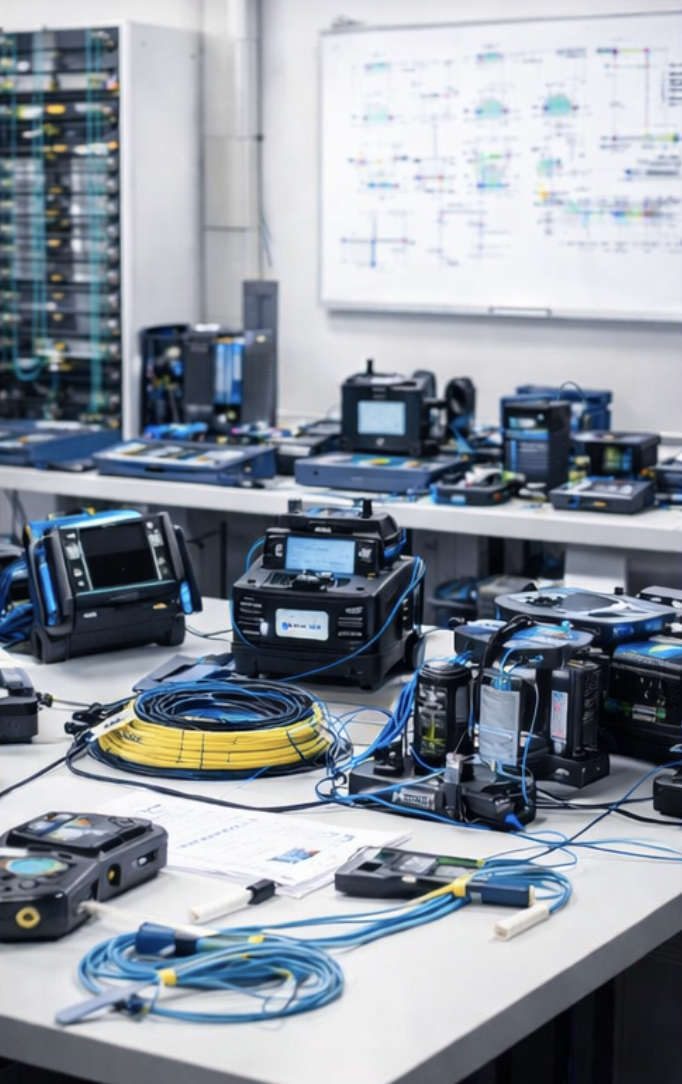
Design and upgrade of technical training centers, including lab configuration, curriculum structure, and trainer selection.
Transformation is to take from dependency on external consultants → to self-sustaining internal training systems that continuously develop technical talent.
This creates operational continuity, internal knowledge transfer and long-term capability scaling.
Schedule a call
If you’re planning a new deployment, upgrading existing infrastructure, or building internal technical capability, this is where the conversation starts.
Every engagement is specialized and tailored to your operation, your standards, your field conditions, your long-term objectives. No generic programs. No recycled material.
Book a call to assess where your infrastructure or training system stands today, and what it needs to perform reliably five years from now.
One more thing.
Why am I the professional for this work?
I combine 25+ years of field engineering, large-scale ICT deployment leadership, and certified technical authority (RCDD / NTS – BICSI) with proven experience designing systems, training teams, and building infrastructure that performs under real operational pressure.
I don’t just design networks.
I design standards, supervision frameworks, and training systems and ensure they work, long after deployment.
I have worked across design, supervision, training, and certification — and I understand how they must function as one system.
Many organizations have already tried other approaches.
They hired a designer who produced drawings but never supervised execution.
They relied on contractors who install efficiently but don’t design for scale.
They delivered training sessions that looked successful, yet field inconsistencies remained.
They certified staff, but costly rework and delays continued.
The problem wasn’t effort. It was fragmentation of roles and lack of fluidity.
I work differently.
I design with field realities in mind.
I train for measurable competence, not just ticking a box.
I supervise against standards that prevent long-term failure.
The result is alignment between design, installation, supervision, and internal capability.
This leads to fewer redesigns, less variability between teams and infrastructure that performs under operational pressure.
This level of integration is rare because most professionals operate in one lane. I have led all of them — under formal standards and in mission-critical environments.
That is the difference.
Contact Me
Interested in working together and have something to say?
Fill out some info and we will be in touch shortly.